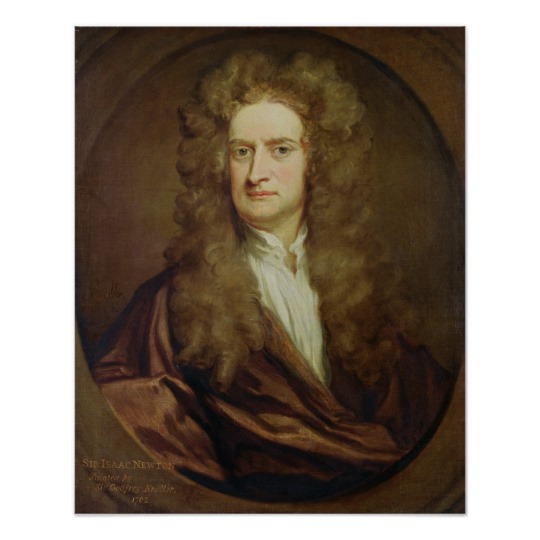
by Sir Godfrey Kneller
oil on canvas, 1702
During the classical era, influences in art started shifting from religious work to art that focused more on the sciences. With advances in astronomy, Sir Isaac Newtons findings, and the discovery of Pompei, the 18th century’s technology was rapidly growing. These scientific discoveries inspired art that focused on realism and historical events while still presenting a playful and light mood. Many works of art were inspired by Sir Isaac Newton after his principles in gravity, development of a color theory and integral calculus, these discoveries would name Newton as one the greatest and most influential scientist to have ever lived (“Isaac Newton”).
The first painting I found that had a connection to Newton and the sciences of the era was a portraiture of Newton himself. This portrait was painted by Godfrey Kneller. In this painting, Newton is given a softer look, with lines bringing realism to Newtons face. The dark background and shading seems to be more like the baroque era, bringing out Newton’s appearance with no distractions. This is a great painting as it gives us insight on Newton himself. In this portrait, Kneller was painting Newton as a public figure, this just shows how both Newton and Kneller were at high points in their careers (“Portraits of Isaac Newton”).
About 30 years later, following Newton’s death, Giovanni Battista Pittoni, and two other artists worked together to create a painting memorializing Newton’s accomplishment. This painting, completed around 1730 had a tomb of Newton surrounded by God’s and ancient scholars (Dominiczak, 2012). This painting featured the light colors, imagination, and rounded architecture, that is presented in the classical eras rococo themes. I really liked how the artist depicted the sciences at the time, using their knowledge of scholars, they symbolized Newton as the greatest scientist of all time with other great scholars mourning his death. The shape of the architecture in this painting really draws the eye the elaborate detail in the architectural structure itself. Generally, lines draw your eye to the focus of the painting, however, the large spacing between the scene and architecture, along with the natural curved lines on the ceiling, brings attention to the detailed patterns in the ceilings décor.

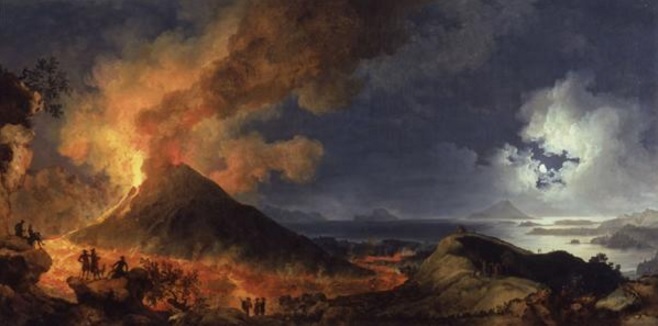
Along with all of Newton’s great discoveries, there were other scientists and advances that shaped the science and art during the classical era. A prime example is the discovery of Pompei. Although the site was discovered in the 1500’s, it wasn’t until the 1700’s that early archeologists started excavating the site. With thorough explorations in the city, it was found that the site was completely preserved, holding the shape and appearance of architecture, objects that shaped the lives of those from the city, and calcified shells that held the shape of the cities encapsulated residents. The scientific theories that came from the site of Pompeii attracted many visitors to the site inspiring writings, paintings, and a thirst for knowledge on the subject matter. Pierre-Jacques Volaire’s painting, An Eruption of Vesuvius by Moonlight, was painted with the city of Pompeii and the eruption that ultimately destroyed the city in mind (“Pompeii’s Influence on 18th Century Art · The Discovery of Pompeii and Herculaneum · Piranesi in Rome”). Volaire imagined the eruption in light, almost peaceful painting. This painting really struck me because of the beautiful scenery and the calmness that is portrayed with the soft, light colors and rococo elements. Half of this painting has colors that bring about calmness, with the blues of the water and the moon peaking out of the soft clouds of the right side of the painting. As you shift your eyes to bright, burning red and orange hues on the left side of the painting, you begin to see the burning volcano coming towards a fearful community. The emotions in this painting make it my favorite out of the three paintings covered.
References
Dominiczak, M. E. (2012, March 1). Science and Culture in the 18th Century: Isaac Newton. Retrieved from http://clinchem.aaccjnls.org/content/58/3/655
Isaac Newton. (n.d.). Retrieved from http://www.absoluteastronomy.com/topics/Isaac_Newton#encyclopedia
Pompeii’s Influence on 18th Century Art · The Discovery of Pompeii and Herculaneum · Piranesi in Rome. (n.d.). Retrieved from http://omeka.wellesley.edu/piranesi-rome/exhibits/show/discovery-of-pompeii-and-hercu/pompeii-art-influence
Portraits of Isaac Newton. (n.d.). Retrieved from https://www.classe.cornell.edu/~critten/gravity/NewtonPortraits.html


 Angela's Art
Hi Angela
I also went with scientific influences for this assignment, the kinds of discoveries and research taking place in this era is fascinating. There’s a lot going on in the second painting you chose, the Allegorical Monument to Sir Isaac Newton, but I think my favorite detail is the beam of light being refracted and then split into the optical color spectrum. I would assume this was included as a way to honor Newton’s work on prisms and light, and it’s cool to see a practical experiment like this depicted in the painting. I also like the distinct contrast in textures between the chiseled edges of the stone architecture and the baggy, billowing clothing of the people depicted.
The third piece you chose has some incredible lighting, the difference between the harsh oranges and reds near the volcano, compared to the softer moonlight on the right makes for a stunning visual effect. The one thing that bothers me on this one is the body language of the figures depicted. It just seems very casual, with a feeling of “huh, would you look at that” rather than the sort of amazement and horror I suspect most people would have in this situation.
LikeLike
I really enjoy the colors in these paintings. They almost appear “dull”, but they give a sense of relaxation. I really like the way you connected the Volcano painting to scientific discovery, as well as appreciate the detail you went into discussing the different colors presented in the painting. My original plan when I first started my blog was to use the scientific discovery theme, however I came up short with ideas. I am impressed with your ability to think outside the box and bring the connections together. The second painting also amazes me, not only because of the immense detail and art elements used to create the realistic effect, but also the fact that someone also had to hand carve all of that architecture.
LikeLike
Hello Angela,
I agree with others that the work around the theme of scientific influences was very interesting. I love learning about science and scientists throughout history. Sir Issac Newton was just one of many scientists that I adore. I focused more on the differences among the artists of the time. I do like how the paintings you chose used light to showcase different elements like contrast and line work. I would not have a painting of a scientist in my house but I would have the painting of Mt. Vesuvius. I loved the bright colors and the simplicity. I enjoy reading about and seeing the art you choose so keep up the good work.
LikeLike
The way your pieces tie together give it a nice flow. I didn’t really think that about looking into scientists themselves for art. That was a nice touch also. The brief history behind Sir Isaac was a great intro and how you continued to flow into how and why the portrait was painted drew you into the subject automatically. The painting itself is very detailed. I always loved this picture. I wonder if it was actually how he dressed normally, like most of the movies about that time portray people, or if it was just the style of high class and was just a costume. I love the shadows and folds in the cloth. It is very detailed. I also love the contrasting differences in the textures. The hair is very fine and blended, almost looking like each strand is painted, compared to the cloth textures and soft facial features. It’s very well done. The second painting is different. It looks colder and almost like an ad. I understand it’s supposed to be a memorial, but compared to many of the other paintings of that time, to me, it’s lacking a bit. I do like that the detail that the piece has, down to the little light/prism reference brought up by bfarnes. I noticed that and wondered a bit of why it was there and when I read that comment I understood. What made it fit even more with your comparisons was the history you tied with it. It continued the flow you began with. The final picture I also happened to use. I really do love this picture a lot! I love the way the colors complement and make the piece look. The way he uses light is awesome also. I would love to own a copy of this picture.
LikeLike