For the non-western exhibit, I decided to focus on Mexican murals. My family roots back to Mexico, and I know nothing about their culture so I thought that an exploration in Mexican art styles might bring me closer to the culture. When looking at the different muralists work, I noticed very similar themes to include politics, hope and inclusion. In this blog, I will be diving into murals created by Jose Orozco, Diego Rivera, and David Alfaro Siqueiros.
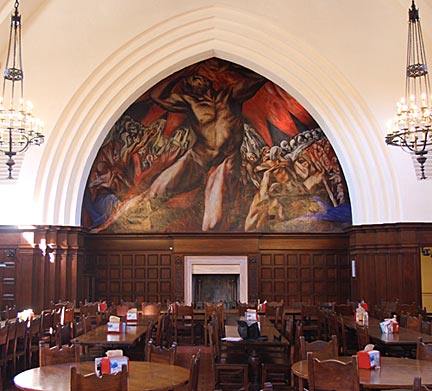
1930
Jose Clemente Orozco
Jose Orozco was a Mexican Muralist from the 1920’s to the late 1940’s who was a part of the Mexican Muralist Movement. Orozco was inspired by his Mexican culture and even destroyed many of his works that he considered “too European.” In 1930, Orozco was commissioned to create a mural in Pomona College, California. Orozco used a giant portrayal of Greek Titan, Prometheus, who creates fire for this mural. The twenty-eight by twenty-foot wall has Prometheus pulling fire down from the sky onto a group of men terrified of their impending doom. It is believed that Orozco was creating a metaphor of his current world (“Prometheus: José Clemente Orozco”). I chose to showcase Orozco’s Prometheus because of the emotions that are pulled from this mural. The red and orange hues and detailed expression of Prometheus really brings the viewer into Prometheus’s wrath. This trusting Titan is pulling fire onto individuals who are now terrified for their lives. While Prometheus is painted with distinct details, the people beneath him are painted with such sweeping strokes that figures can be hard to outline. This makes me feel the power of the titan.
Another notable Mexican Muralist was Diego Rivera. Rivera, who was also a part of the Mexican Muralist Movement, had explored many different cultures to create a very diverse and personalized style for his murals and art work. One of Rivera’s most popular murals takes you into his life. The 50-foot-long mural, “Dream of a Sunday Afternoon in the Alameda Central” walks you from left to life of different Mexican and Rivera’s personal historical markers in life in a chronological order. From presidents and a young Rivera to characters from Mexican mythologies, Rivera depicted a rich history and culture into one mural (“Dream of a Sunday Afternoon in Alameda Park by Deigo Rivera,”). The stories built within this mural are what makes it such an interesting and popular piece. Personally, I like that this piece allows you to read the history from left to right, making me more interested in researching about those depicted. The bright colored center and higher sky makes the eye get drawn directly to the center of the mural. This makes the chronological view more confusing. However, the fade from the darker left side of the painting to the gradual brighter, right side of the painting leads me to believe that hard times had come and gone. This may be a marker in Rivera’s personal life or in the history of the country that molded him. This is my favorite of all of the paintings in this blog. The packed scene and small details make us stop to think. Every time you look at this painting, you can find something new that will bring insight into Rivera’s story.
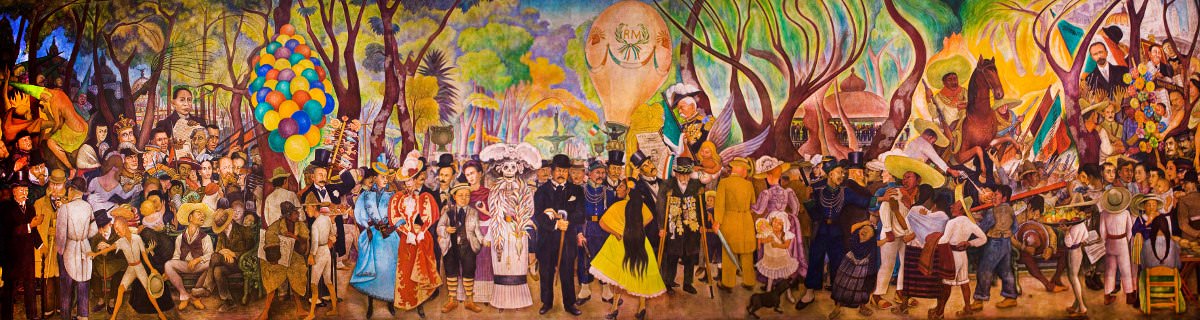
1947
Diego Rivera
Lastly, Mexican muralist David Alfaro Siqueiros. Siqueiros was known for the political side of his murals. One of his most famous being, “The Democracy.” This mural, painted in 1945, was made as a celebratory piece for the victory of fascism after World War 2. A woman is shackled and horrified carrying a freedom flame in one hand and a white flower in the other (“David Alfaro Siqueiros Artworks & Famous Paintings,” ). It appears as if the woman is escaping the past and leaving it far behind her. The facial expression and shackles makes it appear as if the woman is not yet out of the woods and still has more to fight for. This mural reminds me of the Prometheus painting from Orozco. The emotions from both paintings is intense and full of anger with the central figure seeming strong and powerful over everything around them. The styles of both of those paintings is visually appealing in similar ways. The immense detail and brightness of the central figure makes the eye immediately gravitate towards these giant individuals. While the contrasting colors and more faded background around these figures builds on the weaknesses of everyone else.
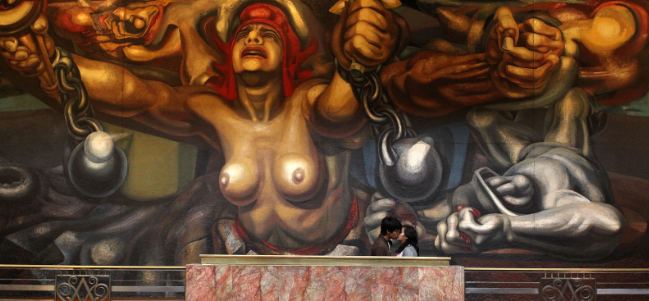
1945
David Alfaro Siqueiros
References
David Alfaro Siqueiros Artworks & Famous Paintings. (n.d.). Retrieved from https://www.theartstory.org/artist/siqueiros-david-alfaro/artworks/
Diego Rivera Maler, Künstler, Genie. (2019, February 18). Retrieved from https://www.fbuch.com/diego-rivera/
Dream of a Sunday Afternoon in Alameda Park by Deigo Rivera. (n.d.). Retrieved from https://www.diegorivera.org/dream-of-a-sunday-afternoon-in-alameda-park.jsp#prettyPhoto%5Bimage1%5D/1/
José Clemente Orozco Artworks & Famous Paintings. (n.d.). Retrieved from https://www.theartstory.org/artist/orozco-jose-clemente/artworks/
» Prometheus: José Clemente Orozco. (n.d.). Retrieved from http://art-for-a-change.com/blog/2014/02/prometheus-jose-clemente-orozco.html


 Angela's Art
Hi Angela
Your post made me remember visiting Guadalajara, Mexico on a class trip many (so many) years ago in middle school and seeing some of the Orozco Murals. I can’t say that they’re the sort of art I would want in my house but they are certainly impressive to see in person and the sheer passion that Jose Orozco put into his pieces is clear. The reds and oranges he often seemed to use really stand out in his mural’s settings, and make them an impressive centerpiece wherever they’re displayed.
LikeLike
Hi Angela
I enjoyed your description of the “The Democracy” I agree with you it does appear as if the woman is escaping, I would also say that the veins in her neck add to the great distress she is in. I also agree that the immense detail and brightness, but I think that it her all together is what bright about the painting. What I do wish is that you made the picture able to zoom, I do like your work thank you.
LikeLike
I really enjoyed your post. I love the pieces you chose, because they were all bold with colors and had interesting meanings behind them. I also liked your analysis of the artistic elements. However, I wish you connected it more to the time period. All in all, it was great.
LikeLike